What Is a Lot Size
Problem-based introduction
Lot size ka matlab samajhna zaroori hai warna position value galat nikal sakti hai. Beginners aksar confuse ho jate hain micro/mini/standard lots ke beech. Is article mein simple Hinglish examples aur GOLD (XAU/USD) se position-value calculations dikhayenge.
Step-by-step explanation
- Standard lot: Traditionally 100,000 units of base currency (applies to currency pairs; for XAU/USD brokers may quote contract size differently).
- Mini & Micro: Mini = 10,000, Micro = 1,000 units. Many brokers offer CFDs and smaller contract sizes for GOLD (e.g., 1 oz contract or fractional lots).
- Pip/pip value: Calculate pip value per lot to determine monetary risk for a stop-loss size.
Real trading logic (GOLD example)
Example: If broker's contract for XAU/USD is 1 oz per lot and price moves 1.00 USD, value change = $1 per lot (depends on broker). Always check your broker's specification and calculate risk per point accordingly. Lekin sirf ye example kaafi nahi. Real trading mein aapko ye sab samajhna padta hai:
Lot Size Impact on Account Risk
Suppose your account is Rs. 2,00,000 and you want to follow the 1% risk rule (Rs. 2,000 max per trade). If you trade 1 standard lot EUR/USD and place a 50-pip stop-loss, your per-pip cost ≈ $10 = Rs. 830 (at 83 INR/USD). Total risk = 50 × Rs. 830 = Rs. 41,500 — far exceeding your 1% limit. So you must use micro lots or fractional sizing: 0.05 lot × 50 pips × Rs. 830 ≈ Rs. 2,075, which is closer to 1%. Ek bhi lot galat ho, account ki durnaali baj jayegi. Issi wajah se beginners ko hamesha micro lots se shuru karna chahiye.
Lot Size Progression (Beginner to Intermediate)
Most disciplined traders follow this path: Start with 0.01 or 0.1 micro lots on demo for months. Paper trade, fail, and learn without money loss. Once you've had 100+ profitable trades on demo with consistency, move to 0.01 live (smallest). Trade that size for 20-30 live trades. Only increase lot size when you've proven profitability AND you can handle the emotional weight of real money. Many traders skip demo and jump to standard lots — result: blown account in 3 months. Aapne dekha hoga ki YouTube pe sab "easy paise" promise karte hain. Sab jhooth hai. Real traders slowly, methodically, carefully increase lot size. Ek saal live trade karte ho 0.01 lot se, consistent profit lete ho, tab 0.05 lot lo. Aur ye process repeat karo — 2-3 saal lage to take account 2,00,000 se 10,00,000 tak le jaane mein. Fast money = no money.
Lot Size vs. Account Size Relationship
Your lot size should scale with account growth. If account doubles, you CAN increase lot size, but the percentage risk remains the same (still 1-2% per trade). This is how professional traders compound: small account → consistent 2% monthly gain → account grows → slightly bigger lots, same percentage risk → more money in absolute terms → cycle repeats. Agar aapka account Rs. 2,00,000 hai aur 2% monthly gain karte ho, to 1 saal mein ~Rs. 2,50,000 ho jayega (before losses). 3 saal mein Rs. 4,50,000 tak. This sounds slow, lekin ye sustainable hai. Beginners who try 10% per month all die on the way.
Image-based examples (mandatory)
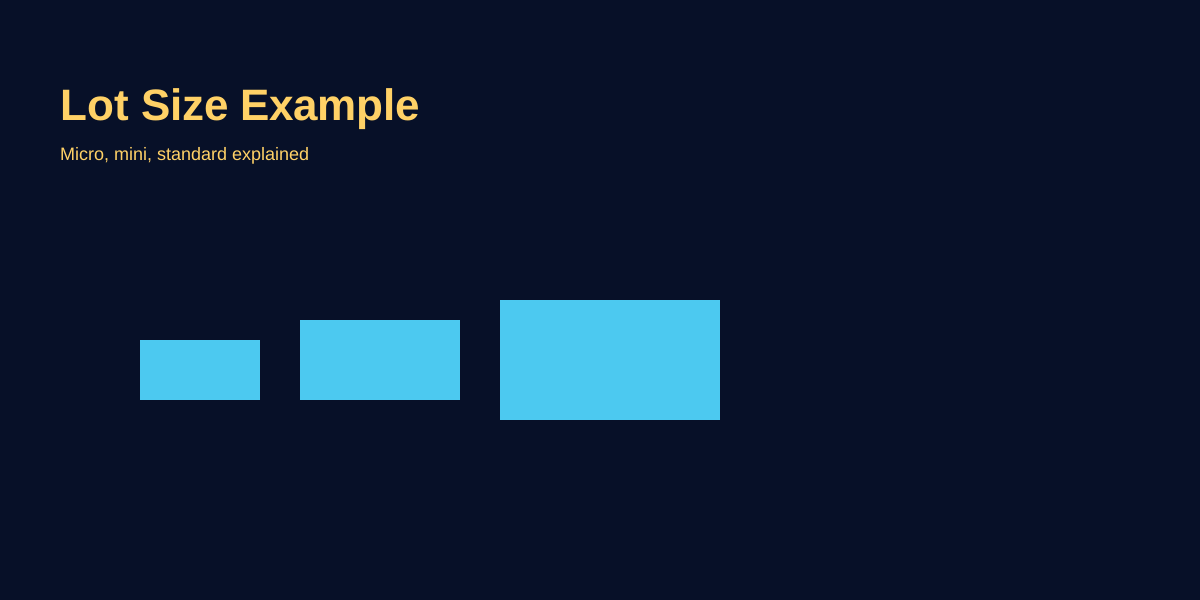
Image explains standard vs mini vs micro lot and shows numeric example for position value.
The Micro-Lot Mastery Framework (First 100 Trades Strategy)
Most beginners fail because they start with too much size. Smart traders start micro (0.01 lots) and don't scale until they've proven an edge. Here's the exact framework professional traders recommend:
Phase 1: Micro-Lot Demo (Trades 1-50)
- Lot size: 0.01 lot (1/100th of standard)
- Purpose: Learn platform, practice entries/exits, build discipline. Zero financial pressure.
- Success metric: 50 trades with ZERO rule violations. Not profit—execution quality.
- Risk per trade: 2% of demo account allowed (psychological freedom)
- Exit rule: If you break your checklist 3 times, restart counter. Quality > speed.
Phase 2: Micro-Lot Live Account (Trades 51-150)
- Lot size: Still 0.01 lot (same Rs. 500-2,000 risk per trade depending on stop)
- Purpose: Real money teaches what demo doesn't—psychology under pressure. Small losses feel real.
- Success metric: 100 consecutive trades following your checklist. Win-rate doesn't matter. If win-rate < 40%, you're missing something—review journal.
- Drawdown tolerance: Max 10% account loss allowed before pause and review. Hit 10%? Stop trading 1 week, journal review mandatory.
- Scaling signal: After 100 trades with positive expectancy (win% × avg win > loss% × avg loss), increase to 0.02 lot.
Phase 3: Scaling with Proof (Trades 151-300)
- Lot size: Increase 20-50% (0.02 to 0.05 lot range)
- Purpose: Build confidence with slightly bigger positions. Real money impact visible but still manageable.
- Success metric: Same 40-50% win-rate maintained. Expectancy still positive? Good sign.
- Fail condition: If expectancy goes negative with bigger lot, IMMEDIATELY drop back to 0.01 lot. Bigger size sometimes changes psychology negatively—size down and reset.
Phase 4: Professional Sizing (Trades 301+)
- Lot size: Scale to your 1% risk rule based on account growth. If account is Rs. 5,00,000 and you want 1% risk (Rs. 5,000), and stop is 50 pips, then size = Rs. 5,000 / (50 × Rs. 100/pip) ≈ 1 lot or fractional depending on pip value.
- Purpose: Your system is proven. Now compound wealth with calculated, risk-managed size.
- Rule: Still check account balance monthly and recalculate position sizes. Account grows, size should grow proportionally.
Real-World Lot Size Scaling Timeline (Beginner → Professional)
This is a realistic timeline many successful traders follow. Your mileage may vary, but patience is consistent across ALL successful traders:
| Phase | Duration | Lot Size | Account | Risk/Trade |
|---|---|---|---|---|
| Demo Learning | 3-6 months | 0.01-0.05 lot | $10,000 demo | 2% (no real cost) |
| Live Micro (Rs. 2L account) | 6-12 months | 0.01 lot | Rs. 2,00,000 | Rs. 500-1,000 |
| Live Scaled (Rs. 3-4L) | 12-24 months | 0.02-0.05 lot | Rs. 3,00,000-4,00,000 | Rs. 1,500-2,500 |
| Professional (Rs. 10L+) | 24+ months | 0.1-0.5 lot | Rs. 10,00,000+ | Rs. 5,000-10,000 (1% rule) |
Key insight: Notice the 2-3 year timeline. People who skip demo (3-6 months saved) almost always blow up before year 1 ends. People who follow this timeline consistently reach Rs. 10,00,000+ by year 3. Patience = profit. Rushing = ruin.
Common Lot Size Mistakes (Detailed Solutions)
Mistake 1: Starting Too Big (\"I Have Rs. 2,00,000, So I'll Trade 0.5 Standard\")
Impact: EUR/USD moves 30 pips against you. Loss = 0.5 lot × 30 pips × Rs. 100 ≈ Rs. 1,500. Painful but OK. Then 5 consecutive losses = Rs. 7,500 down (3.75% account). Psychology breaks. Next trade you miss obvious setup because you're scared. Drawdown spirals. Fix: Start 0.01 lot regardless of account size. Emotion doesn't scale with math—it scales with real losses feeling real. Micro lots = less emotional damage = clearer thinking = better decisions.
Mistake 2: Scaling Too Fast (\"I Won 5 Trades, Time to Double Size\")
Impact: 5 wins is sample size 5, not 100. Could be luck. You double size, next 5 are losses, now you're angry and size up even more (revenge). Blowout within 50 trades. Fix: Scale only after 100+ trades with consistent expectancy. Rule: \"Never increase size mid-month.\" Only at month-end if metrics support it. This forces patience.
Mistake 3: Same Lot Size Across Different Volatility (\"I Trade 0.05 Lot in Slow Asian Session AND Volatile London\")
Impact: Same 0.05 lot, but London volatility is 3x Asian. Your stop-loss on London setup = double the distance. Risk unintentionally doubled. Fix: Adjust lot size by volatility. If London has 100-pip moves vs Asian's 30-pip, reduce London size by 30%. Volatility-adjusted sizing = more consistent risk.
Mistake 4: Not Adjusting for Account Growth (\"I've Traded Rs. 2L Account for 1 Year at 0.01 Lot, Now It's Rs. 4L but Still 0.01\")
Impact: Your account doubled, but position size didn't. You're earning 0.5% monthly when you could earn 1%. Opportunity cost over years = massive. Fix: Quarterly lot-size review. If account grows 20%, increase lot size by 10% (half the growth) after next 25 profitable trades confirm edge still works.
Mistake 5: Using Leverage to Compensate (\"Lot Size 0.01 Is Too Small, Let Me Use 100x Leverage\")
Impact: High leverage + small lot = still dangerous. Flash crash, broker margin call, stops not honored. Same risk with less control. Fix: Ignore leverage. Focus on lot size and stop distance only. Leverage is broker's tool, not your trading tool.
Lot Size Planning Worksheet
Use this simple template before trading any session:
- Account balance: Rs. ___________
- Risk per trade (1-2%): Rs. ___________
- Expected stop-loss (pips): ___________
- Pip cost per 1 standard lot: Rs. ___________
- Calculated lot size = Risk / (Stop loss × Pip cost) = ___________
- Approved? Yes / No
Fill this before EVERY trade. Mechanical approach = no emotions, less mistakes.
Pro Tips
- Use demo for 3-6 months before going live: Learn how different lot sizes behave. Don't skip this.
- Automate position-size calculation: Use broker tools or create a simple spreadsheet to avoid mental math errors during trading.
- Review broker contract specs quarterly: If you switch brokers or instruments, contract size may differ. Re-verify your pip costs.
- Set maximum lot size per trade as a rule: Even if math allows 0.5 lot, cap yourself at 0.1 if you're emotional. Rules > math sometimes.
- Start small, stay small, scale slowly: This is the only rule that separates winning traders from bust traders. Patience in lot sizing = wealth.
Risk Warning
Different instruments have different contract sizes—always verify and manage risk per trade.
SEO FAQs
- 1. Lot size kya hota hai?
- Lot size trading contract ka unit definition—how much of the base asset one lot represents.
- 2. GOLD lot size kitna hota hai?
- Broker-specific—some brokers use 1 oz, others use mini contracts; always check.
- 3. Kaise calculate karein position value?
- Position value = lot size * price * conversion (if needed). Use broker spec and account currency to calculate risk.