Price Action Trading — Read Price, Not Noise (English + Hinglish)
Introduction
Price action trading means reading raw price movement and market structure without over-relying on indicators. Yeh approach market ke behaviour ko simple aur pure form me padhta hai. This article explains structure, levels, common setups, and a simple practice plan.
Core idea: price reflects everything
Price incorporates fundamentals, sentiment, liquidity and order flow. Jo sab kuch market me ho raha hota hai wo ultimately price me reflect hota hai. Isliye price action traders charts ko primary source maante hain. Indicators lagging hote hain — wo price ke baad calculate hote hain. But price itself real-time hai. Jab aap candles pe focus karte ho — open, high, low, close — to aap market ka rawest form dekh rahe ho. Institutions, retail, algorithms — sab ke orders price mein merge hoke ek single candle bante hain. Ye simplicity powerful hai.
Why Price Action Works Better Than Indicators
Indicators are derivatives of price. Moving averages recalculate every candle; RSI calculations lag by 14 periods. But raw price shows you rejection wicks, engulfing candles, structure breaks — all in real time. Agar aap ek support level pe dekhte ho ki price ne ek long lower wick chhoda aur bullish close kiya, to ye signal fresh hai. Indicator wait karega 5-10 candles tak confirm hone tak. Price action traders pehle execute kar chuke hote hain. Issi wajah se professionals prefer karte hain clean charts with minimal indicators.
Market structure — swings & trends
Identify structure by looking at swings: higher highs & higher lows for uptrend, lower highs & lower lows for downtrend. On break of structure, bias changes. Always check higher timeframe first (daily/4H) to form a directional bias. Structure breaks ko confirm karne ke liye close important hai, not just a spike. Agar candle wick se level cross karta hai but body close level ke andar hota hai, to fake breakout hai. Confirmed break = clean body close beyond the level.
Advanced Structure Concepts: Break of Structure (BOS) vs Change of Character (ChoCh)
Professional traders differentiate between BOS and ChoCh:
- Break of Structure (BOS): Price breaks a previous swing high (in uptrend) or swing low (in downtrend) — continuation signal. For example, EUR/USD in uptrend breaks previous high at 1.1050; this BOS confirms bullish momentum continuation.
- Change of Character (ChoCh): Price breaks structure in the OPPOSITE direction — reversal warning. Example: uptrend breaks a higher low to the downside — this ChoCh suggests trend may reverse. Wait for confirmation candle or retest before entering counter-trend.
Ye concepts Smart Money Concepts (SMC) framework se aate hain, but rooted in pure price action. Beginners ke liye zaroori nahi initially; intermediate traders benefit karte hain identifying early reversals se.
Multi-Timeframe Structure Alignment
Best setups tab aate hain jab structure multiple timeframes pe align ho. Example:
- Daily: Uptrend (HH/HL clear)
- 4H: Pullback into demand zone, bullish structure intact
- 1H: Bullish engulfing candle at 4H demand zone
Yeh alignment high-probability setup hai. Counter-example: Daily downtrend but 1H uptrend — counter-trend trades risky hote hain. Hamesha HTF ke saath align trade karo unless aap experienced scalper ho.
Support & resistance — zones, not lines
Key levels are areas where price paused or reversed before. Use zones instead of exact lines and watch for role reversal. Combine these with structure for higher-probability entries.
Common price action setups
- Pullback in trend: Wait for price to pull into a level and show reversal candle. Best during London session after Asia consolidation. Wait for 4H candle close for confirmation, don't chase wicks.
- Breakout + retest: After a breakout, wait for retest of breakout level to enter with better risk. 60% of breakouts retest within 6-12 candles. Patience pays here — early breakout chasers often get trapped.
- Range trade: Buy near range support, sell near range resistance with tight stops. Range ki width minimum 50 pips honi chahiye intraday trades ke liye. Narrow ranges (20-30 pips) avoid karo — risk:reward poor hota hai.
- Liquidity grab + reversal: Price spikes beyond a level (stop-loss hunting), then reverses sharply. Experienced traders enter on the reversal candle. Risky for beginners — requires screen time to recognize fake-outs.
- Failed breakout (spring/upthrust): Price breaks a level, fails to sustain, reverses back into range. This traps breakout traders and provides excellent counter-trend entry. Wait for close back inside range before entering.
Setup Quality Grading System
Not all setups are equal. Grade your setups A/B/C:
- A-Grade: HTF aligned, clean level, confluence (trendline + zone), confirmation candle, news-clear session. Trade these with full size (1% risk).
- B-Grade: Missing one factor (e.g., HTF neutral but intraday structure clean). Trade with 0.5% risk.
- C-Grade: Messy, multiple retests, conflicting signals, or news-heavy time. Skip or paper-trade only.
Journal mein setup grade track karo. Over time, A-grade setups consistently better perform karenge. C-grade setups ka win-rate 40% se neeche hoga typically. Filter karo low-quality trades aur consistency improve hogi.
Price Action — FAQs
Glossary: breakout, retest, structure.
Entry rules & stop placement
Entry after confirmation: a clean candle close or a retest. Stop below invalidation zone (not random pips). Determine stop size and then calculate position size to fit your dollar risk.
Higher timeframe confluence
Daily ya 4H bias fix karo, phir intraday (1H/15m) par trigger lo. HTF swing high/low ke paas counter-trend scalps avoid karo; trend-aligned trades ko priority do.
Two ready-to-use setups
- Break–retest–continuation: Range/structure break, retest, small confirmation candle. Stop beyond retest wick, target next HTF level. Best in London/NY overlap.
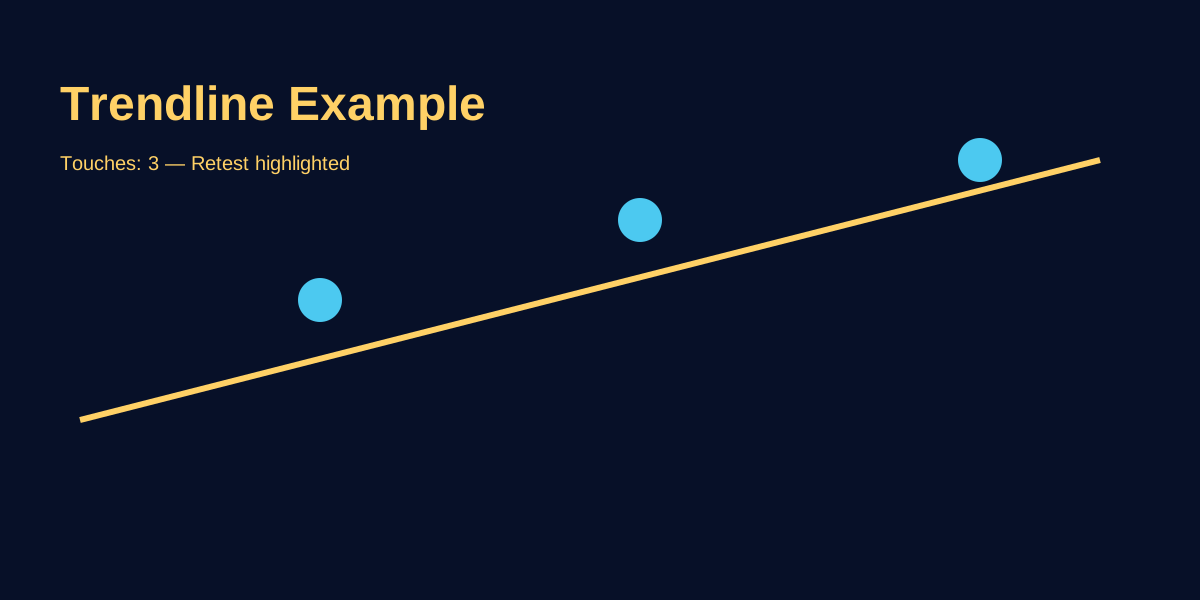
- Trendline + zone confluence: Clean trendline meets horizontal zone; rejection candle triggers entry. Stop below/above confluence. Avoid multiple messy lines.
Practice plan to master price action
- Spend time marking higher timeframe structure each day.
- Backtest simple setups on 4H and daily charts.
- Demo trade 50–100 setups to learn live behaviour.
- Keep a journal with screenshots and observations.
Risk management & journaling
- Risk 0.25%–0.5% per intraday trade; 1% max for swing.
- Journal: setup tag (A/B), session, entry trigger, stop distance, R:R planned vs hit.
- Mark reasons for deviation (slippage, news, emotion) and reduce size if discipline slips.
Weekly review: remove low-quality setups, double down on A-grade patterns.
Common mistakes
Overtrading, ignoring higher timeframe context, and using too-tight stops are common issues. Patience and repeatability beat complicated systems.
Session and news awareness
Asia = quieter, range-friendly; London/NY overlap = break + continuation; major news time = spike risk. News ke 5–10 min pehle size half ya flat.
Emotional discipline in setups
Patience beats FOMO. Agar setup validate nahi hua to trade skip karo; perfect setups regularly aate hain. Weekend holds pe size reduce karo (gap risk). Hindsight mein mistakes obvious dikhte hain, lekin live mein discipline survive karti hai. Rules likho, follow karo, journal karo aur improve karo.
Conclusion
Price action is a robust way to trade as it focuses on the actual market behaviour. Master structure, levels, and risk management — and practice consistently. Agar aap in steps follow karoge, aap price-action trading me confident ho jaoge. Remember: price action is not magic —it's systematic observation, pattern recognition, and disciplined execution. Ye ek skill hai jo practice se develop hoti hai, not overnight.
The Long Game: Price Action as a Career Skill
Professional traders who've survived 10-15 years all have one thing in common: they read price, not indicators. Kyun? Because price tells you where smart money is positioned, where liquidity pools exist, and where market is likely to move. Indicators can't do this. Price action traders adapt faster to changing market conditions because they're not dependent on fixed indicator parameters. Agar market character change hoti hai (e.g., low volatility to high volatility), indicator-based traders struggle. But price action traders simply adjust stop distances and timeframes — the core structure-reading skill remains the same.
Next Steps: Building Your Price Action System
- Week 1-2: Mark structure daily on 5 pairs. No trading — just observation.
- Week 3-4: Backtest 50 setups on demo. Document structure, entry, stop, outcome.
- Week 5-8: Forward-test 50 more setups on demo with size you'll use live.
- Week 9+: Go live with smallest size (0.01 lot). Trade 30 setups live. Review after 30.
- Month 4-6: If profitable and consistent, slowly scale size. Target 2% monthly with <10% max drawdown.
Ye process slow lagta hai, but 6 months systematic practice se aap ek solid foundation build karoge. Fast shortcuts don't exist — only disasters waiting to happen.
Real edge in price action
Edge nahi ata breakout ke setup se; edge ata discipline se. Wait, confirm, execute small, journal, improve. Ek saal mein 50–100 setups do aur patterns dekho; edge emerge hoga.
Want annotated chart screenshots or downloadable practice checklist? I can add PNGs next.
Quote: Read the price — it tells the story, you just need to listen.