Trendlines — The Correct Way
Problem-based introduction
Trendlines draw karte waqt beginners aksar arbitrary lines draw kar dete hain. Yeh article clear rules aur validation steps provide karta hai, with GOLD examples for practical clarity.
Step-by-step explanation
- Use higher timeframe swings for anchor points.
- Prefer at least two clear touches—three is better.
- Adjust for wicks but prefer body-based confirmation for entry decisions.
How To Draw Trendlines Correctly (The Rules)
Rule 1: Use Higher Timeframe Swing Points — Don't connect random wicks on 1M chart. Use daily or 4H swing highs/lows as anchor points. Example: GOLD daily chart. You see swing low at 2000 on Day 1, another at 1995 on Day 10. Draw line through these (not through wicks on intraday). This is your uptrend support.
Rule 2: Minimum Two Touches, Three Is Better — Trendline with only 1 point = random line (no validity). With 2 points = possible line (needs validation). With 3+ touches = strong line. More touches = higher reliability. Example: EURUSD has touched 1.1000 support level 4 times over 3 months. This is a strong level, not a weak line.
Rule 3: Prefer Body Closes, Not Just Wicks — Price can wick through a level but candle close above/below trendline matters more. If price wicks below trendline on a 5-pip wick but closes 20 pips above, trendline is NOT broken. Wait for candle close through line, not wick.
Rule 4: Don't Redraw After Price Breaks It — Traders often redraw trendlines to fit narrative. "That line wasn't valid, let me draw a new one." No. If price breaks trendline, accept it and move on. Redrawing = curve-fitting, destroys objectivity. Stick to drawn lines, accept breaks, trade accordingly.
Rule 5: Check Timeframe Alignment — 4H trendline should NOT contradict daily trendline. If 4H shows bearish trendline down but daily trendline is up, conflicting signals. Use daily trendline for bias (major trend), 4H for entry timing (pullbacks to 4H trendline in direction of daily trend).
Using Trendlines for Trading (Practical Setups)
Setup 1: Bounce Off Trendline (In Trend)
Uptrend established (daily above 100MA). Price pulls back to uptrend trendline (support). Wait for bounce: (1) Bullish candle at trendline, (2) Close above trendline, (3) Volume. Enter long, stop below trendline. Target: Previous swing high. This is pullback trade on support, reliable in trending markets (55-65% win).
Setup 2: Trendline Break + Retest (Reversal)
Strong uptrend for weeks. Price approaches steep uptrend trendline. Breaks below trendline + closes outside. BUT: Price immediately bounces back to trendline (retest). Enter short on the retest bounce (second touch below line = confirmation). Stop above trendline. This is breakout + retest, high-probability (60-70% win when daily trend aligns).
Setup 3: Trendline Break Without Retest (Strong Reversal)
Price breaks trendline decisively, doesn't retest. This is STRONG break, likely reversal. Don't wait for retest (it may not come). Enter immediately after break, stop above break candle. Aggressive entry (55-60% win) but captures big moves on strong breaks.
Trendline Traps (Common Failures)
- Drawing lines arbitrarily on 5M chart. You draw a trendline on intraday noise. Price "breaks" it on a single 5-pip wick. Invalid. Use daily/4H swing points, not intraday noise.
- Buying/selling at the line without confirmation. You buy JUST as price touches uptrend support line. Price continues down through line (wick). You stop out. Better: Wait for bounce candle + close confirmation, THEN enter.
- Not adjusting for instrument volatility. GOLD trendline should be less sensitive to wicks (GOLD wicks big). Adjust trendline to touch BODIES not wicks. For EURUSD (less volatility), touching wicks is okay.
- Using too steep trendlines. Ultra-steep uptrend line will break frequently (fragile). Use slope that market respects for 5+ touches. If line too steep, it's not really a trendline (just curve-fitting).
Real trading logic (GOLD example)
Use trendline breakout with retest for entries on XAU/USD; combine with volume or momentum indicator for confirmation.
Image-based examples (mandatory)
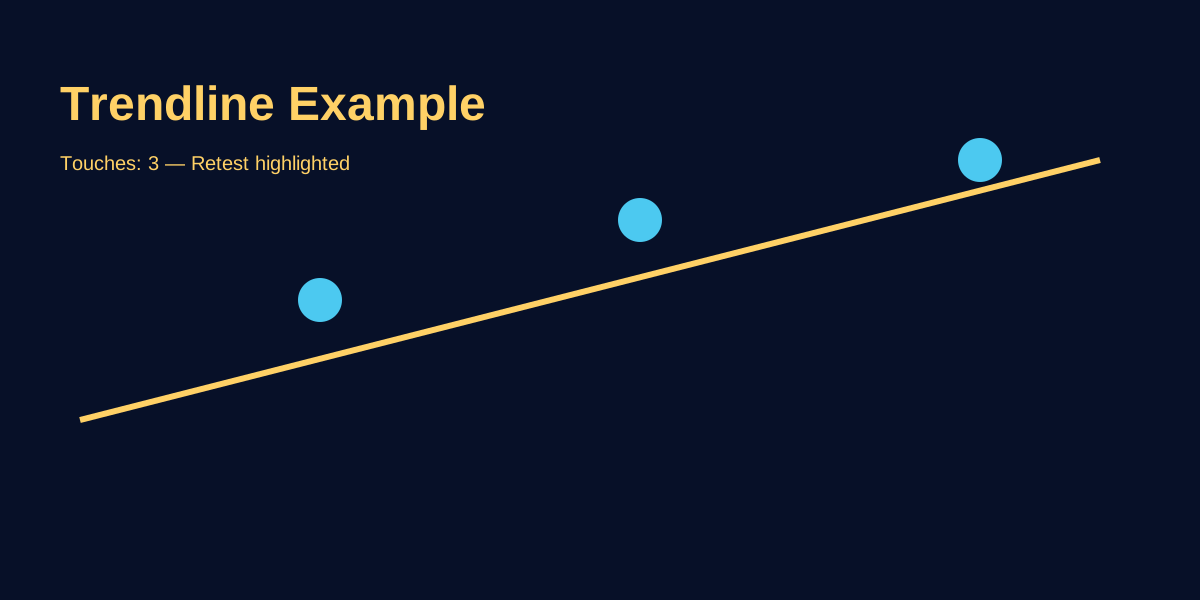
Annotated trendline on GOLD chart showing touches and retest entry.
Common Mistakes
- Redrawing lines to fit preferred outcome. Price breaks your trendline, you redraw to make it "valid." This is self-delusion. Accept breaks, don't redraw. One trendline per trend; stick with it.
- Using trendlines from noisy, low-timeframe data without context. 5M trendline on noisy chart = meaningless. Use daily/4H trendlines on quiet timeframes. Context is timeframe.
Pro Tips
- Use trendline slope to gauge momentum; shallow slopes indicate slow moves. Steep uptrend slope = strong momentum, but fragile (breaks easily). Shallow slope = slow momentum, but robust (holds longer). Choose your strategy: catch steep moves (risky) or ride stable slope (safer).
- Combine trendline breaks with candle confirmation and volume. Break alone = could be wick. Break + bullish candle close + volume = confirmed break. This combo is 60-70% reliable.
Risk Warning
Trendline breaks can fail—use stop-loss and proper sizing.
SEO FAQs
- 1. Trendline kitna reliable hai really?
- Depends on: (1) Timeframe (daily trendline > 5M trendline), (2) Number of touches (3+ touches > 2 touches), (3) Price action (close confirmation > wick touch). Strong trendline (daily, 4+ touches, 4H entry confirmation) = 60-70% reliability. Weak trendline (5M, 2 touches, no confirmation) = 45% reliability.
- 2. Trendline break: Immediate short, ya retest wait?
- Depends on break strength. Decisive break (large candle, high volume) = enter immediately (after close confirmation). Weak break (small candle, low volume) = wait for retest. Strong breaks (60% win) often don't retest. Weak breaks (50% win) frequently retest or fail.
- 3. Kya trendline draw karne ka automatic tool sahi hai?
- Auto tools help speed up process but manual validation is key. Tool draws line through swings, but you must check: (1) Does this line respect market structure? (2) Is this line too steep/shallow? (3) Do higher timeframe levels align? Trust tool for speed, but verify manually.
- 4. Daily trendline vs 4H trendline: Kaunsa use karun?
- Daily: Trend bias (bullish/bearish direction). 4H: Entry timing (bounces to 4H support in direction of daily trend). Example: Daily uptrend line = bullish bias. 4H downtrend line = pullback phase. Buy 4H bounces OFF 4H trendline in daily uptrend direction. Both together = powerful combo.
- 5. GOLD pe trendline: Steep slope ya shallow better?
- GOLD is volatile. Very steep uptrend line breaks often (whipsaws). Shallow uptrend line holds longer. For GOLD, prefer 45° angle slopes (balanced). Test: If trendline breaks 5x without reversing, too steep, adjust.
- 6. Trendline wick touch vs candle close: Kaunsa count?
- For drawing line = both count (wick and close can touch line). For trade entry = close only. Wick can touch line without breakout. Wait for candle close to confirm break.
- 7. Trendline too many times redraw: Kaunsa moment accept break?
- Accept break when price closes (not wick) on opposite side of line + volume confirms. If this happens for 1-2 days, break is likely real. Don't redraw hoping it bounces back. Move on, trade the break.
- 8. Multiple trendlines same trend: Which one use?
- Use oldest/strongest one (most touches). If you have two uptrend lines (inner + outer), use outer line (connects older swing lows, more robust). Inner line can be local correction, not true trend.
- 9. Trendline break + retest: How long to wait for retest?
- Usually 2-5 candles. If price breaks line and doesn't retest within 10 candles, retest unlikely. Don't wait forever. Either enter on original break or wait for fresh setup.
- 10. Support/resistance level vs trendline: Kaunsa stronger?
- Both important but different: S/R level = horizontal, static (2100 support stays 2100). Trendline = dynamic, changes as price moves (support rises as uptrend continues). Use both: S/R for major zones, trendlines for trend entries/exits.